
Copyright Lawyer in Washington, DC
DC runs on original work: reports, research, journalism, podcasts, photography, campaigns, courses and code. Drishti Law helps the people and organizations who create it register their copyrights, settle who owns what, and act quickly when someone copies their work or claims you copied theirs.
- Registration and ownership
- Takedowns and infringement claims
- Phone, email and video meetings
Where copyright questions come up in DC
Most of the calls we get from DC clients start with one of these.
Reports and publications
A nonprofit or association pays a consultant to write a white paper, then learns the consultant may own it. Ownership terms belong in the contract, before the work starts.
Media and podcasts
Clips, music beds, quotes and cover art. We help shows and newsrooms work out what needs a license and when fair use realistically applies.
Photos online
Your photos turn up on someone else's site, or you get a demand letter over an image your team posted. Both sides of that problem have clear next steps.
Websites and software
Code, apps and site content built by agencies or freelancers. If the ownership language is missing, you may only have a license to your own platform.
Courses and training
Online courses, workshop materials and slide decks are easy to copy and resell. Registration makes them much easier to protect.
Music and art
Songwriters, producers, visual artists and designers who want their catalog registered and their licenses written properly.
Ownership is automatic. Enforcement isn't.
Your copyright exists the moment the work is fixed in a file, a recording or on paper. Registering it with the U.S. Copyright Office is what gives that right some teeth.
You can go to court
For works first published in the U.S., you generally need a registration (or a refusal) before you can file an infringement lawsuit.
Damages without proving losses
Register before the infringement starts, or within three months of publication, and you can ask for statutory damages of $750 to $30,000 per work (up to $150,000 for willful infringement) plus attorney's fees.
A head start on proof
A registration made within five years of publication is treated as evidence that your copyright is valid and that the facts in the certificate are true.
How we help DC copyright owners
Copyright registration
Single works, collections and group registrations, filed correctly so the certificate holds up when you need it.
Learn more →Infringement claims
Demand letters, platform reports and negotiated licenses when someone is using your work without permission.
Learn more →Defense against claims
Got a demand letter or a lawsuit threat? We check whether the claim holds up and what it's really worth before you pay or reply.
Learn more →DMCA takedowns
Fast removal of copied content from websites, hosts and social platforms, with a paper trail if it comes back.
Learn more →Counter-notices
Your content was taken down by mistake? A properly prepared counter-notice can get it restored.
Learn more →Licenses and assignments
Contractor agreements, licenses and assignments that spell out who owns the work and how it can be used.
Learn more →All copyright services we offer
The four questions behind every fair use argument
Commentary, criticism, news reporting, teaching and research can all qualify as fair use, but nothing qualifies automatically. Courts weigh four factors together.
Purpose of the use
Is it commercial? Does it add new meaning or comment on the original, or just repackage it?
Nature of the work
Using factual material is easier to justify than using highly creative work like fiction, music or art.
How much was used
Both the quantity and the importance of the portion matter. A short clip can still be the heart of the work.
Market effect
Does the use replace sales or licensing the owner would otherwise get?
Giving credit doesn't turn a use into fair use. If you're relying on fair use for something that matters, get it reviewed first.
Where copyright cases in DC are heard
Copyright infringement claims arise under federal law, and only federal courts can hear them. In the District, that's the U.S. District Court for the District of Columbia, with appeals going to the U.S. Court of Appeals for the D.C. Circuit.
For smaller disputes, the Copyright Claims Board offers a voluntary alternative for claims up to $30,000. It sits within the U.S. Copyright Office on Capitol Hill, though its proceedings are handled online, so parties don't need to be in DC.
Plenty of disputes never get that far. A clear demand letter, a takedown notice or a negotiated license resolves most of them. If you've received a notice yourself, read how to respond to a copyright infringement notice before you reply.
Who we work with in DC
- Nonprofits, associations and think tanks
- Journalists, publishers and podcasters
- Photographers and visual artists
- Musicians, songwriters and producers
- Agencies, consultants and educators
- Software developers and startups
Cannabis trademark services
Federal trademark rules for cannabis are still restrictive and still changing, so protecting a dispensary or product brand needs its own plan. That plan usually combines carefully drafted federal filings with copyright protection for creative assets like logo artwork and packaging designs.
DC Cannabis TrademarksCopyright questions from DC clients
Do I need to register my work to own the copyright?
No. You own the copyright as soon as the work is fixed in a tangible form. Registration matters when you want to enforce it: for U.S. works it's generally required before you can sue, and registering early makes statutory damages and attorney's fees available.
Can I use a photo I found online if I credit the photographer?
Usually not. Credit isn't the same as permission. Unless the photo is licensed for your use, in the public domain or your use is a genuine fair use, posting it can lead to a takedown or a demand for payment.
Who owns a report written by a consultant for our organization?
Generally the consultant, unless your contract includes a written assignment or the work qualifies as a work made for hire. It's one of the most common ownership surprises for DC nonprofits and associations, and it's easy to fix in the contract up front.
Is work created by the federal government protected by copyright?
Works prepared by federal government employees as part of their official duties aren't protected by U.S. copyright. Work created by contractors or grantees can be, depending on the terms of the contract or grant.
What is the Copyright Claims Board?
A voluntary small-claims tribunal within the U.S. Copyright Office for disputes involving up to $30,000 in damages. It's faster and cheaper than federal court, but the other side can opt out.
How much does copyright registration cost?
The Copyright Office charges a filing fee that depends on the type of application, and a new Copyright Office fee schedule takes effect on January 5, 2027. We confirm the current government fee when we file, and quote our own fees upfront after a free consultation.
Videos and podcasts
Short videos and a podcast episode on copyright and other intellectual property topics.

Crafting Your Response: A Strategic Guide To Handling A Copyright Infringement Notice
Podcast: Intellectual Property on Law Subscribed
Serving clients throughout Washington, DC
We work with DC clients by phone, email and video, from Capitol Hill and Georgetown to Navy Yard and Anacostia. Need trademark help too? See our DC trademark services.
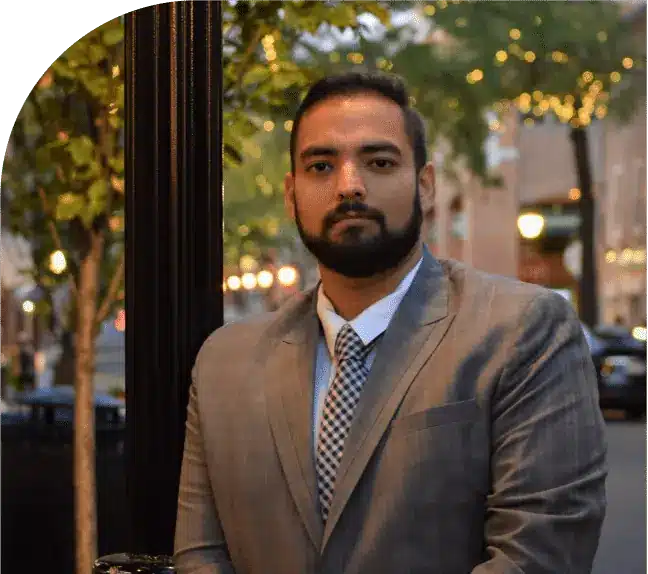
Sahil Malhotra
Sahil is admitted to practice in the District of Columbia and Illinois. He earned his J.D. at the University of Illinois Chicago School of Law, where he worked in the school's IP clinic, and later clerked at the U.S. Patent and Trademark Office before founding Drishti Law.
Read Sahil's Bio